// ai agents · 7 October 2026 · 4 min read
I Built a Tiny Claude Code Plugin
Lessons from building Ayat of the Day, a Claude Code plugin and CLI
 Muhammad MairajSenior Backend Engineer
Learning in public has been part of how I work for years, pick something small, build it, write down what breaks along the way. The latest “something small” was a tiny Claude Code plugin.
What I built
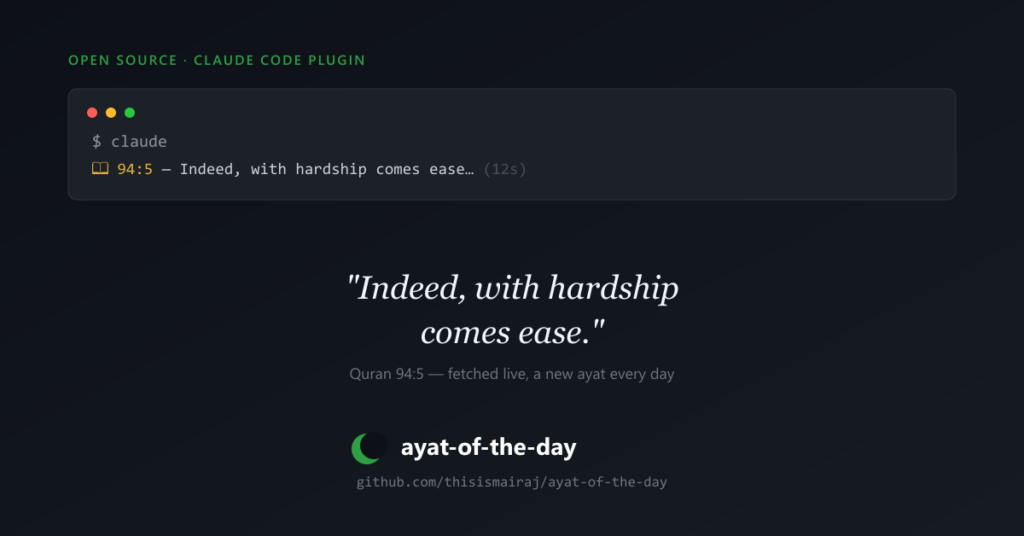
Claude Code shows a spinner word while it’s thinking, “Sauteing…”, “Proofing…”, that kind of thing. I swapped that word for a real verse from the Quran, fetched live, same one for everyone on a given day. Nothing fancy. But building it meant poking around parts of Claude Code I’d never touched before, and that’s where the real learning happened, not in the finished plugin, in the mess before it.
It’s not just a Claude Code thing, either, it also works as a plain CLI, anywhere, no Claude Code involved at all. Code’s on GitHub: github.com/thisismairaj/ayat-of-the-day. Published on npm too: npmjs.com/package/ayat-of-the-day, just run npx ayat-of-the-day in any terminal.
How to use it
Two ways, depending on what you want:
As a Claude Code plugin, it just shows up while Claude’s working, nothing to remember:
/plugin marketplace add thisismairaj/ayat-of-the-day
/plugin install ayat-of-the-day
As a plain CLI, works anywhere, Claude Code or not:
npx ayat-of-the-day           # full verse, formatted
npx ayat-of-the-day --status  # one line, for scripts or status bars
npx ayat-of-the-day --json    # {"ref","text","date","stale"}
Why I think it’s worth using
“Ayat” just means a verse, here, specifically a verse from the Quran, Islam’s central text. The idea of a daily verse isn’t new or unique to Islam; plenty of traditions have “verse of the day” apps. What’s different here is where it shows up: not a separate app you have to remember to open, but the one spot you’re already staring at and doing nothing, the moment Claude’s spinner is spinning.
For Muslim users, that’s a small, recurring touchpoint with scripture, folded into a tool you already have open all day. For anyone else, it’s a tiny, low-effort window into a text you might never otherwise pick up, same verse as everyone else that day, fetched live from a real translation (Saheeh International via api.alquran.cloud), not something generated or hardcoded. No pressure either way, it’s just there instead of “Sauteing…”.
What shipping it in public actually taught me
Your first idea is usually wrong, and that’s fine.
My first attempt used Claude Code’s built-in status API, assuming that was the real status-line hook. It wasn’t, it’s a separate notice row the engine always labels with the plugin’s name, no way to turn that off. I had to go find the actual hook into the spinner’s message instead. If I’d built this quietly and shipped the first version, I’d have had something a little broken and no idea why it looked off.
“It’s not working” sometimes means “it’s not running.”
I fixed a bug, tested it, and nothing changed. I spent a while assuming my fix was wrong before realizing I’d forgotten to bump the plugin’s version number, Claude Code checks that number, not the actual code, to decide whether to reload. The installed copy was happily running my old, broken code the entire time.
Writing it down is what caught the mistake, not the other way round.
I only understood why the plugin’s command matcher had to be a literal string, not a shared variable, while I was writing the explanation out for myself. That’s the part nobody tells you about learning in public: the writing isn’t reporting what you learned. It’s how you learn it.
Try this yourself
- Pick something you already use every day, not a six-month idea sitting in your notes.
- Build the dumbest version that works, not the “right” one.
- Write down the mistake the moment it happens, not from memory, later.
- Ship it even if only you and three other people will ever use it.
This isn’t a one-off for me
I’m a huge fan of open source, this plugin is just the latest small thing in a pattern I keep repeating. Alongside it, I’ve been building other projects, playing with real datasets, and honing my Databricks and Snowflake skills, all the same way: pick something small, build it in public, write down what breaks along the way.
It didn’t need to be big
None of this needed a big project. A spinner message and three dumb mistakes taught me more about how Claude Code’s plugin system actually works than a week of just reading docs would have. The “learning exhaust” wasn’t the plugin, it was the mistakes I made building it, written down while they were still fresh.
So: what’s the small thing you’ve been meaning to build, instead of just reading about it?
Muhammad Mairaj is a Senior Backend Engineer with 8 years building payment and data systems. He writes about data engineering, measured. More about him.