// payments · 22 November 2026 · 6 min read
What happens when you tap your card, explained simply
A beep at the till hides four parties, two trips, a few fees and a payment that is not finished yet.
 Muhammad MairajSenior Backend Engineer
You tap your card, the terminal beeps, and the screen says approved. It takes a moment. Behind that moment, at least four parties have talked to each other, a security code has been made and thrown away, and the money still has not moved.
This post walks through the whole trip: the seconds at the till, the slower part that happens later, who takes a cut, how phone and online payments differ, and what happens when you ask for your money back.
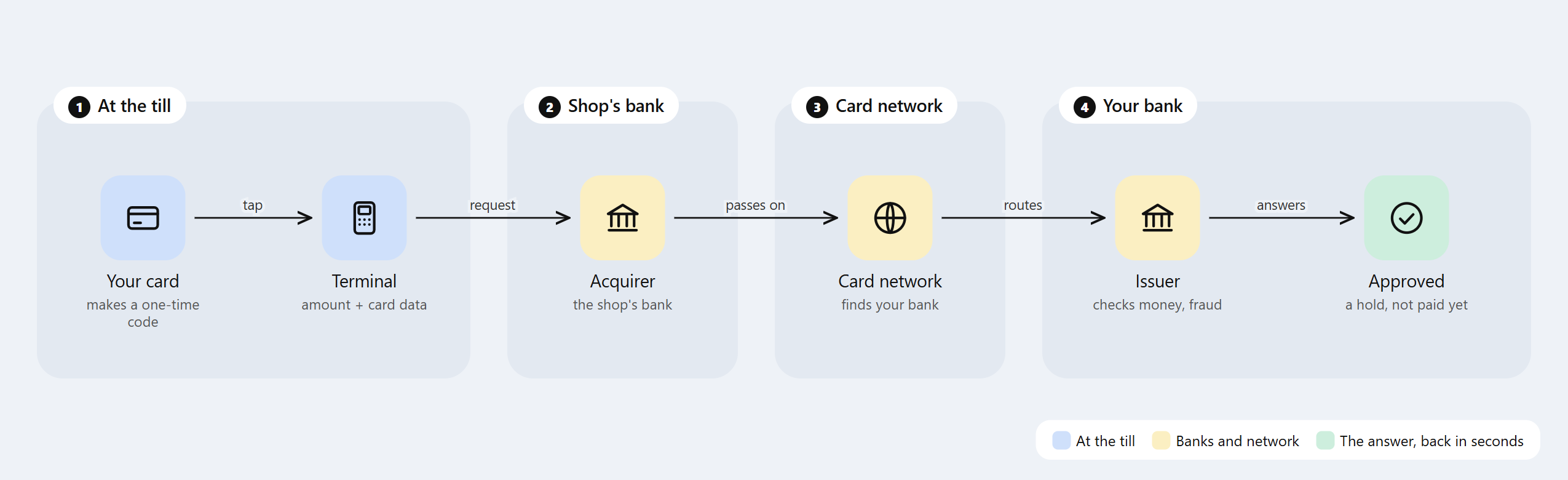
The four players
- You, the cardholder. You hold the card, or a phone with the card inside it.
- The acquirer. The shop’s bank, or a payment company working for the shop. It accepts card payments on the shop’s behalf and later pays the shop.
- The card network. Visa, Mastercard and others. It connects thousands of banks, so the shop’s bank does not need a direct line to yours. It also sets the rules everyone follows.
- The issuer. Your bank, the one that gave you the card. It decides yes or no, and it is the one that takes money from your account.
You will also hear about payment processors and gateways. They are companies that do the technical work for an acquirer or a shop. They make card payments easier for a shop to set up, but the four roles above stay the same.
The seconds after you tap
1. The card makes a one-time code. The chip in a contactless card creates a fresh security code for every payment. EMVCo, the group behind the chip standard, describes it as a one-time code generated for every transaction to guard against fraud. Copying it does not help a thief, because it is no good for the next payment.
2. The terminal sends a request. It packs the amount, the card details and that code, and sends them to the acquirer.
3. The network finds your bank. The acquirer passes the request to the card network. The network reads the card number, works out which bank issued it, and sends the request there.
4. Your bank decides. The issuer checks the request and says approved or declined.
5. The answer goes back the same way. Issuer to network, network to acquirer, acquirer to terminal. The terminal beeps. All of that usually fits inside the moment you wait at the till.
What your bank checks
The yes or no is not one check. It is a short list, run in a fraction of a second:
- Is the card real? The one-time code shows the chip is genuine and the request was not copied.
- Is the card usable? Not blocked, not reported lost, not expired.
- Is there room? Enough money in the account for a debit card, or enough credit left for a credit card.
- Is it within limits? Daily limits, and limits you may have set yourself, such as no online or no foreign payments.
- Does it look like you? A fraud check compares the payment with your usual habits: the place, the amount, the time.
Fail any one of them and the answer is declined. That is why a decline rarely means the card itself is broken.
Approved is not paid
This is the part most people miss. An approval does not move money. It puts a hold on it: your bank sets that amount aside so you cannot spend it twice. Stripe’s guide to authorization holds explains why: card payments happen in two steps, an authorization and a settlement, with a gap in between.
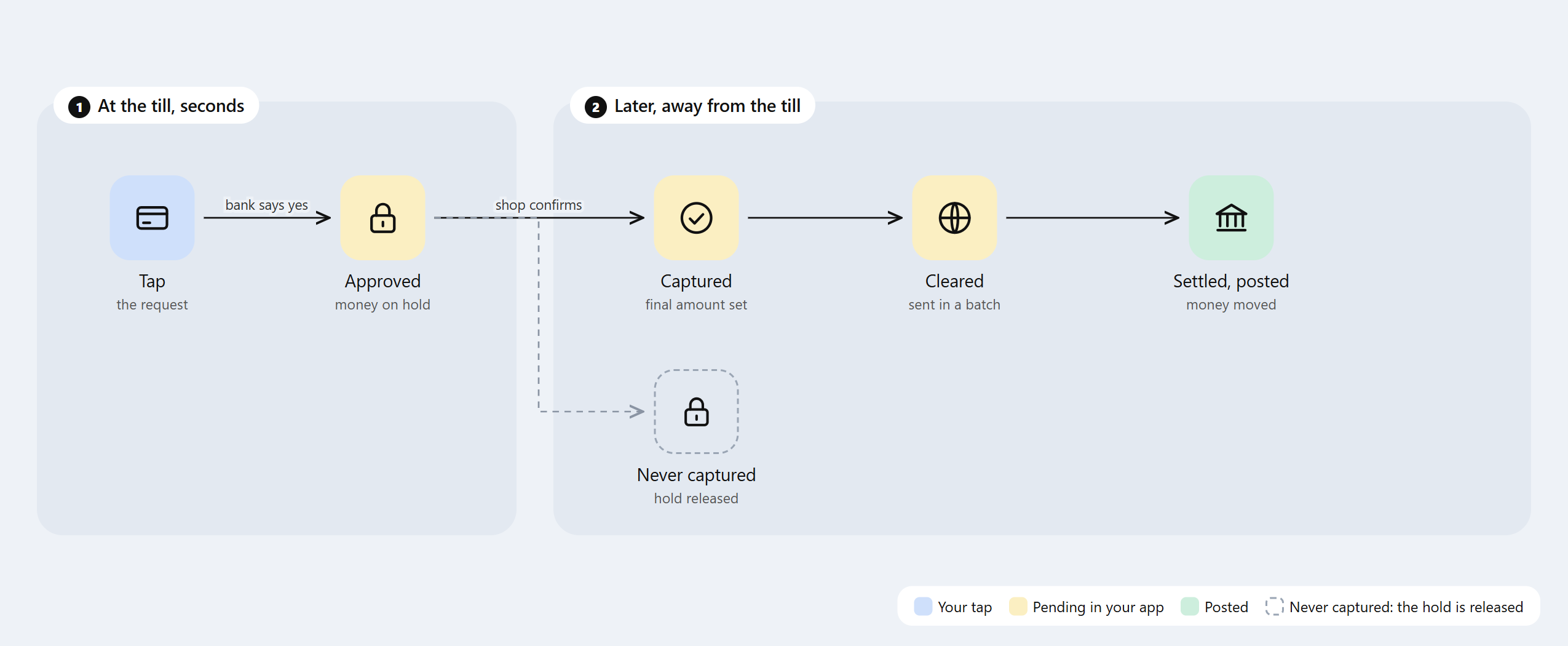
From there, one of two things happens:
- The shop captures it. Capture means the shop confirms the sale and the final amount. Stripe’s guide says the hold is then replaced by a final charge for the actual amount, which can be lower or higher than the hold.
- The shop never captures it. Then the hold expires or the bank releases it, and the money goes back to your available balance.
That is why your banking app shows a payment as pending first. Pending means approved and on hold. Posted means the money actually moved. A hotel or a fuel pump often holds more than you finally pay, because the final amount is not known yet when you hand over the card.
Later: clearing and settlement
The second half happens away from the till.
- Clearing. The shop sends its captured payments to the acquirer, usually in a batch. The acquirer sends them through the network to each card’s bank. Everyone now agrees on the final amounts.
- Settlement. The money moves. Your bank pays, the network passes it along, the acquirer receives it and pays the shop.
So one tap is really two trips: a fast one that asks “can this person pay?” and a slower one that actually pays.
Who takes a cut
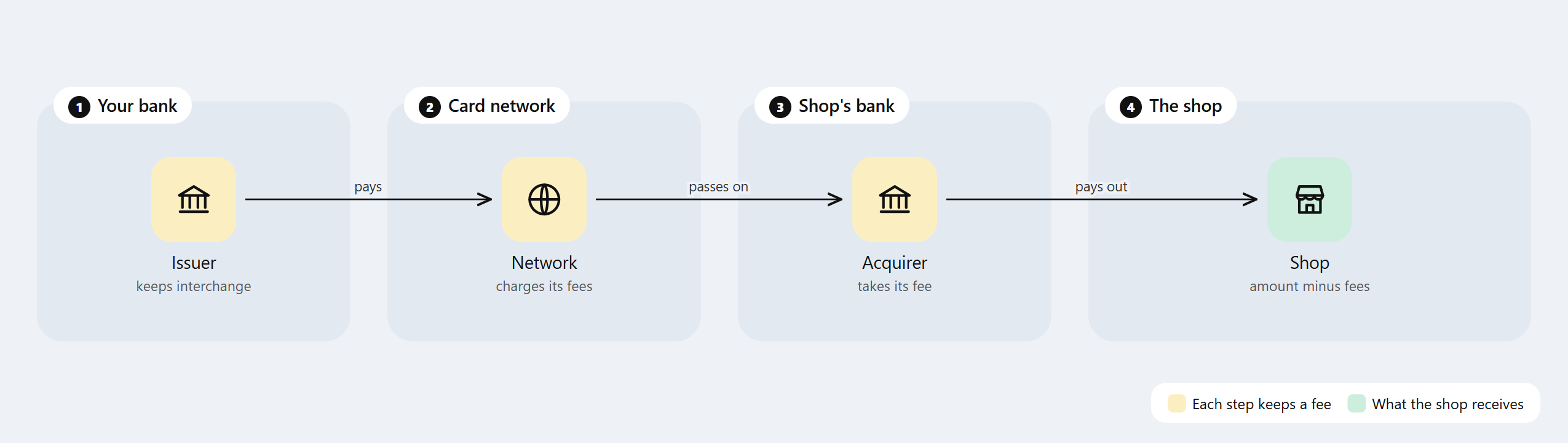
The shop does not receive the full amount. Fees come out along the way:
- Interchange. Usually the biggest piece, and it goes to your bank. Visa describes interchange as a transfer fee between acquiring banks and issuing banks for each transaction.
- Network fees. The card network charges for running the system.
- The acquirer’s fee. The shop’s bank or payment company charges for its service.
Shops usually see these as one rate on their statement. Behind that one number are the three pieces above, which is what a shop means when it says card payments cost money.
Phone wallets and online payments
Paying with a phone, or typing your card into a website, follows the same trip with one extra safety step each.
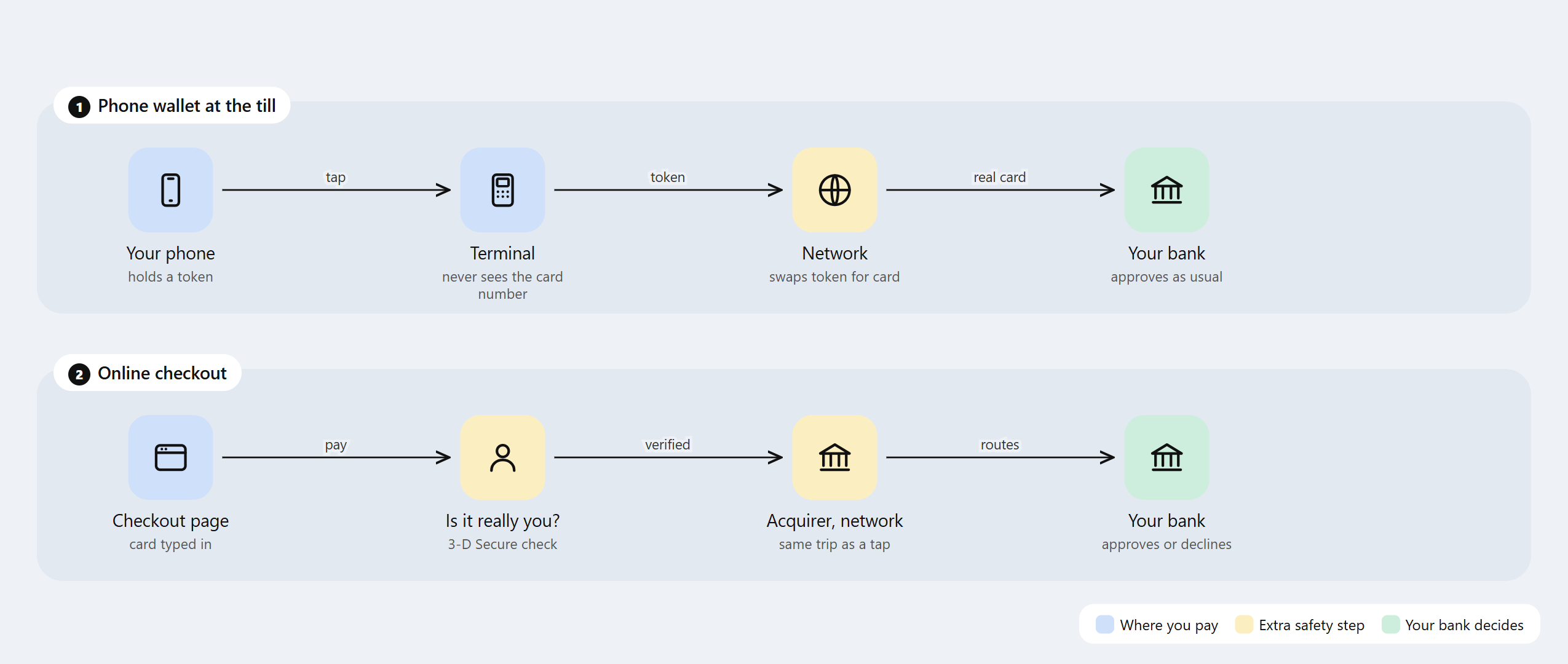
Phone wallets use a token. Your phone does not store your real card number. It stores a stand-in called a token. EMVCo explains that tokenisation replaces the card number with a unique alternative value, and that the token is limited in how it can be used, for example to one device or one merchant. If a shop’s system is ever breached, the token is of little use anywhere else.
Online payments check that it is you. On a website there is no chip to tap, so anyone with your card details could try to use them. That is called card-not-present fraud. EMV 3-D Secure lets the shop and your bank exchange data to confirm it is really you, sometimes by asking you to approve in your banking app or enter a code. Then the payment makes the same trip as a tap.
Refunds and chargebacks
There are two ways money comes back to you, and they are not the same.
- A refund is started by the shop. It agrees to give the money back and sends it through the same chain in reverse. Because it travels the slow path, it can take days to show up.
- A chargeback is started by you, through your bank, when the shop will not help. Stripe defines a chargeback as a reversal of funds following a card purchase, set in motion when the customer files a dispute with their bank.
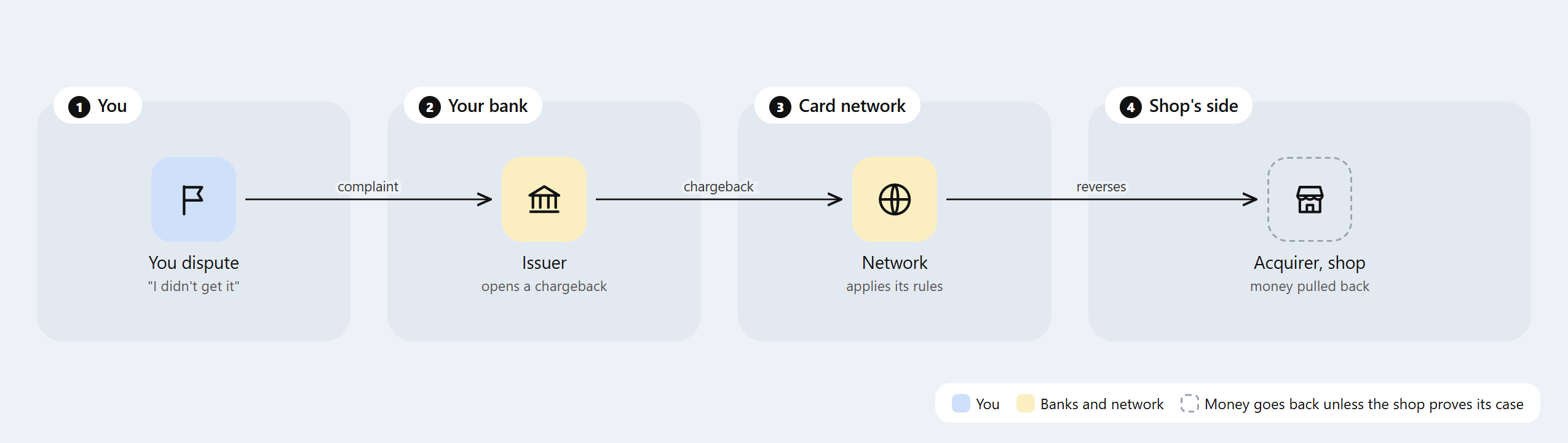
A chargeback is not instant and not automatic. The shop gets a chance to answer with proof, such as a delivery record, and the card network’s rules decide who is right. That is also why shops work hard to avoid them.
Common mix-ups
- “It was approved, so it is paid.” Not yet. It is a hold until it is captured and settled.
- “The pending amount is wrong.” Sometimes it is just the hold. The final amount arrives with capture and clearing.
- “I was charged twice.” Often it is one pending hold and one posted charge for the same payment, and the hold drops off later.
- “Declined means my card is broken.” Usually it means one of the bank’s checks said no: funds, a limit, or a fraud signal.
- “The shop’s bank and my bank talk directly.” Normally they do not. The card network sits in the middle.
- “A refund and a chargeback are the same.” A refund comes from the shop. A chargeback comes from your bank, after a dispute.
A small glossary
- Authorization: the bank’s yes or no at the till.
- Hold: money set aside after a yes, not yet taken.
- Capture: the shop confirming the sale and its final amount.
- Clearing: exchanging the final payment details between banks.
- Settlement: the actual movement of money.
- Interchange: the fee the acquirer’s side pays to the card’s bank.
- Token: a stand-in for your card number, limited in where it can be used.
- Chargeback: a reversal your bank starts after you dispute a payment.
The recap
- Four players: you, the acquirer, the card network and the issuer.
- The tap asks your bank for permission, and the answer comes back in seconds.
- Approval is a hold. Capture, clearing and settlement move the money later.
- Fees are shared along the way, mostly as interchange to your bank.
- Phones add tokens, websites add a check that it is really you.
- Refunds come from the shop. Chargebacks come from your bank.
Next time the terminal beeps, you will know it is only the first half of the story.
Muhammad Mairaj is a Senior Backend Engineer with 8 years building payment and data systems. He writes about data engineering, measured. More about him.