// ai agents · 12 October 2026 · 5 min read
wrap-it-up: context engineering you can see as a graph
A command that gives every Claude Code session zero recap
 Muhammad MairajSenior Backend Engineer
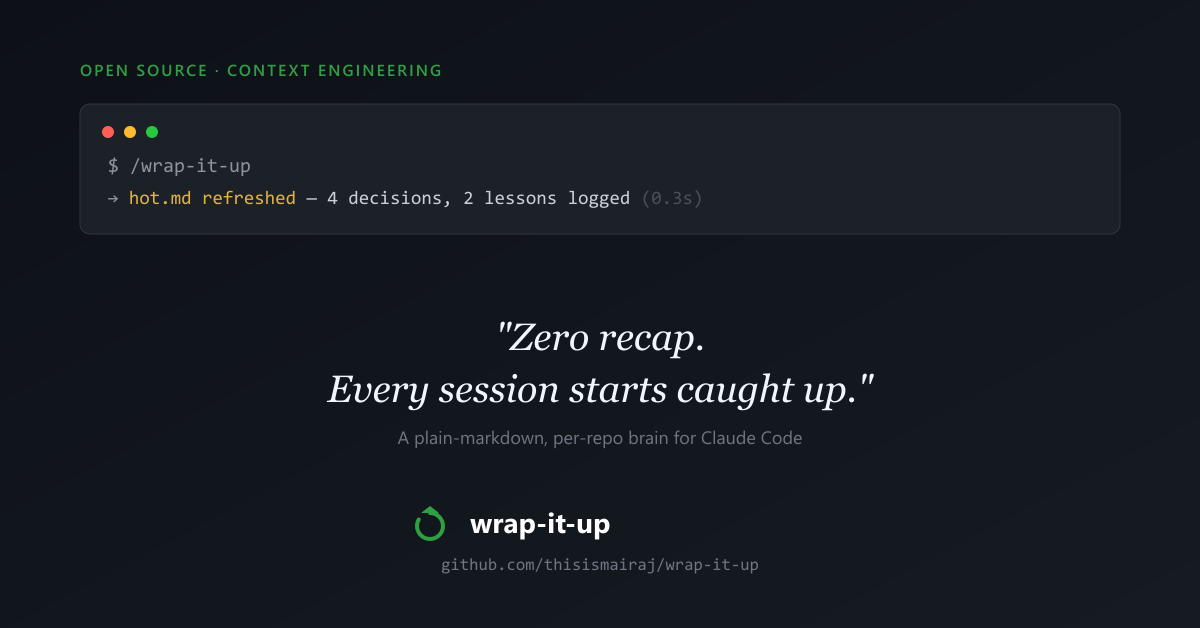
Every new AI coding session starts the same way: you re-explain what the project does, what you decided last week, the bug you already fixed. Multiply that across every session, every day, and you’re spending real time just getting the AI caught up, before it’s written a single line.
I’ve written before about why context engineering, what’s actually in the model’s window, not just how you phrase one message, matters more than people give it credit for. This is that idea applied to the single most repetitive part of using Claude Code: the start of every session.
I’ve also spent a lot of my career mentoring junior engineers, and onboarding always comes down to the same thing: the faster someone has real context, the faster they’re actually useful. An AI session has the exact same problem, just compressed into minutes instead of weeks. So I built the thing I kept wishing existed: a command that closes the loop.
What it does
wrap-it-up is an open-source command for Claude Code. At the end of a session, you type /wrap-it-up, and it writes down what actually happened – decisions made, lessons learned, what’s still open – into a small folder inside your own repo:
Decision: switched to a single install command instead of separate OS-specific scripts, because every extra choice is a reason someone bails before trying the thing.
Lesson: don’t assume a “sandboxed” test is actually sandboxed, verify it touched what you think it touched.
That’s the shape of it, short, specific, dated. The next time Claude starts a session in that repo, it reads that folder automatically before you’ve typed a word. Zero recap, every time, in both directions, it writes the context out when you stop, and loads it back in when you start.
npm install -g wrap-it-up-cliThat’s the whole install. It wires itself up, no extra steps, no config file to hand-edit.
What’s actually in the folder
Open it up in any repo that’s using it and it’s just four things:
logs/– one file per day, a running diary of what happened. Most of it is forgettable by design, and that’s fine – it’s not meant to last forever.wiki/– the stuff that is meant to last. Not everything from a session deserves a permanent page, but a real decision or a hard-won lesson does, so it gets promoted out of that day’s log into its own page – one concept, one page, updated in place the next time it comes up instead of duplicated.hot.md– a short, current summary, maybe 500 words, refreshed every time you wrap up. This is the one Claude actually reads at the start of a session – not the full history, just where things stand right now.index.md– the front page. What the project is, what’s durable about it, links to every wiki page.
The split matters more than it looks. A day’s log is cheap and disposable. A wiki page is expensive and permanent, it earned its place. And hot.md is the compressed version of both, the one thing actually worth loading every single time. Most tools either keep everything, so you’re scrolling through noise to find what matters, or keep nothing, so you’re back to re-explaining. This only keeps what’s actually worth keeping.
Why it’s not a vector database
Most “AI memory” tools on the market right now, Mem0, Zep, Cognee, the usual names, are real infrastructure: an API or SDK, an extraction pipeline, often a hosted service or a database you stand up yourself. They’re built for a different job, giving a chatbot or an AI product persistent memory across thousands of users and conversations, and for that job, they’re genuinely good at what they do.
wrap-it-up isn’t trying to be that. There’s no service, no API key, nothing to embed or extract. It’s markdown files, sitting in your own repo, that you can open and read like any other file. You can git diff what changed. You can grep it. For one developer working in Claude Code, that’s a better trade than standing up infrastructure to remember what you decided last Tuesday.
This is the same shift I wrote about separately: context engineering as the thing that actually succeeds prompt engineering, not a bigger model or a cleverer prompt. Most of what makes an AI session good or bad happens before you type anything.
See it as a graph, not just files
Here’s the part most people miss: because every wiki page is just markdown with real links between pages, you can open any of your repos directly in Obsidian, File → Open folder as vault, no plugin required, and get an actual graph view of how your decisions and concepts connect to each other. A project that’s been wrapped up a few dozen times stops being a folder you’d have to scroll through and starts being something you can actually look at.
This is the same idea a lot of people are already doing with Claude Code and Obsidian as a “second brain”, one big vault, a CLAUDE.md telling Claude how to behave, a daily-notes habit. wrap-it-up gets you the same visual payoff, just scoped to one repo instead of your entire life, and git-native instead of a vault you maintain by hand.
What it’s actually for
It’s genuinely about not losing time. If you work across several projects, and most backend engineers I know do, the context-switch cost of picking a project back up is real, not just annoying. A few decisions written down properly save you from relearning the same lesson twice, and a short session-end habit pays for itself the very next time you open that repo.
It’s also honest by design: if a session didn’t produce anything worth keeping, it says so, instead of padding the log to look productive. I’ve spent a lot of time on the compliance side of fintech, where a record that overstates what actually happened isn’t a style choice, it’s a real problem, that instinct carried straight over here. A tool meant to keep your context accurate shouldn’t lie to make itself look useful.
Try it
Repo: github.com/thisismairaj/wrap-it-up
npm: npmjs.com/package/wrap-it-up-cli
If you’re juggling more than one AI-assisted project, this is the smallest change that’s actually made a difference for me. A star on the repo helps it reach the next person re-explaining their codebase for the twentieth time.
Muhammad Mairaj is a Senior Backend Engineer with 8 years building payment and data systems. He writes about data engineering, measured. More about him.